


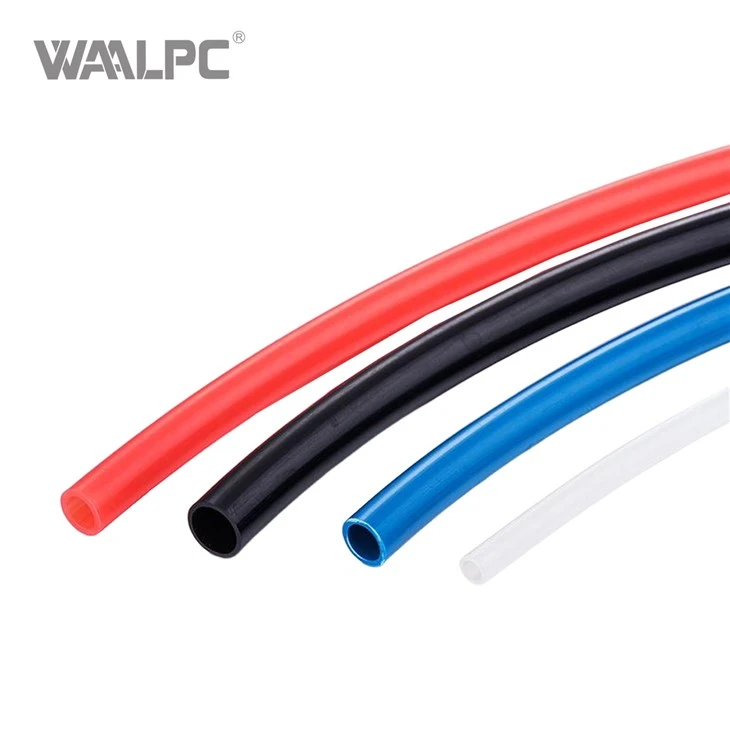


Hangzhou Evershine Pneumatic Import & Export Co., Ltd. is one of the leading manufacturers and suppliers of nylon pneumatic tubing in China. With abundant experience, we are committed to providing high quality pneumatic components to global clients. Welcome to wholesale custom made nylon pneumatic tubing from our factory. Also, OEM service is available.
We've supplied PA tubing to factories and machine builders for years, and it's become the go-to choice for applications where PU just can't handle the pressure. Nylon tubing – also called polyamide pneumatic tubing – is tough, abrasion-resistant, and handles heat and pressure far better than softer materials. One customer running a high-speed packaging line told us he switched to nylon after blowing through PU lines every few months. He hasn't had a failure since.
Whether you're running high-pressure air lines, routing through hot environments, or dealing with constant mechanical wear, nylon pneumatic tubing is worth a closer look.
Product Introduction
Nylon Pneumatic Tubing – PA6, PA11, and PA12 Polyamide Air Hose for Industrial Compressed Air Systems is designed to solve a very real problem that we see all the time in demanding pneumatic applications – hoses that fail under pressure, heat, or mechanical stress.
The WAALPC nylon pneumatic tubing range tackles that head-on. It provides the pressure resistance, thermal stability, and abrasion resistance that heavy-duty pneumatic systems require. Nylon tubing (Polyamide) is significantly stiffer than PU or PE, which means it holds its shape, resists deformation under pressure, and stands up to harsh industrial environments.
This tubing is suitable for air, water, and various chemicals depending on the specific PA grade. It's available in metric and inch sizes, including the popular 1/4 pneumatic hose size (6.35mm O.D.). Standard colours include black, white, blue, red, and natural – with custom colours available on request.
Whether you're building high-pressure test equipment, installing fixed air lines, or replacing failed hoses in a tough environment, this nylon pneumatic tubing does one thing well: it holds up. That's the whole point.
【Feature】– What you actually get
The nylon series covers the sizes and grades that handle demanding pneumatic applications:
PA6 / PA11 / PA12 Grades – Each grade offers slightly different performance characteristics. PA6 is the standard general-purpose grade. PA11 and PA12 offer better flexibility and moisture resistance.
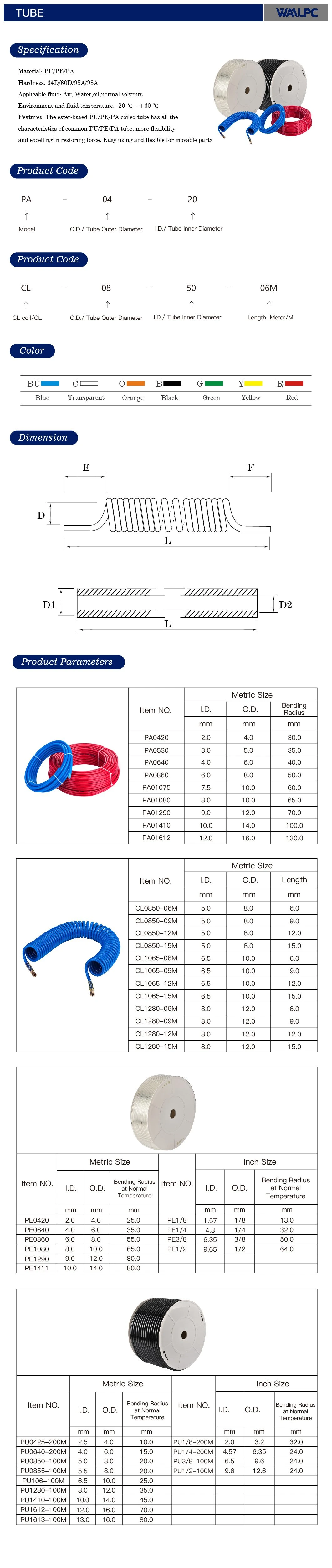
Metric sizes – I.D. from 2.0mm to 12.0mm, O.D. from 4.0mm to 16.0mm.
Inch sizes – including 1/8", 5/32", 1/4", 5/16", 3/8", and 1/2". The 1/4" O.D. size is a common choice for general pneumatic lines.
Length options – 100m and 200m reels as standard. Custom lengths available.
Colours – Black, white, blue, red, natural. Other colours available on request.
Temperature range – -40°C to +80°C for standard PA6, with PA11/PA12 handling up to +100°C for short periods.
All tubing is compatible with push-in fittings, compression fittings, and standard barbed fittings.
【Advantage】– Why this tubing earns its place
The first thing people notice is the pressure capability. Nylon tubing handles working pressures that would cause PU or PE tubing to burst. It's the material of choice for high-pressure pneumatic systems where safety and reliability are non-negotiable.
The second thing is thermal stability. Nylon doesn't soften or deform at elevated temperatures the way softer plastics do. That means it keeps performing in hot environments – near ovens, engines, or industrial processes where heat is a fact of life.
And then there's the abrasion resistance. Nylon is tough. It resists the wear and tear that comes from routing through metal panels, moving machinery, or rough industrial environments. That toughness translates directly into longer service life and fewer replacements.
【Benefit】– What it means on the shop floor
Let's keep this practical.
Fewer failures under pressure. Nylon tubing holds up where softer materials fail. That means fewer unplanned stoppages, fewer safety incidents, and more consistent production.
Longer service life. The abrasion and heat resistance of nylon means it outlasts PU or PE in demanding applications. A tubing that lasts years instead of months pays for itself many times over.
Better performance in hot environments. If your pneumatic lines run near heat sources, nylon is the practical choice. It keeps its shape and pressure rating where other materials soften and fail.
Simpler inventory. One tubing family covers a wide range of sizes and pressure ratings. You don't need to juggle multiple product lines or guess whether the tubing on your shelf is up to the job.
【Evidence】– The numbers behind the tubing
We test this tubing the same way we test everything else – under conditions that mimic real use, not laboratory ideals.
The PA series handles temperatures from -40°C to +80°C for standard PA6, with PA11 and PA12 grades handling up to +100°C for short durations. Hardness ranges from 64D to 95A depending on the specific grade.
Working pressure varies by size – smaller diameters handle higher pressures. A 1/4" O.D. nylon tube typically handles working pressures up to 1.0 MPa or higher, depending on the wall thickness and temperature. Burst pressures are significantly higher, giving you a safe margin for pressure spikes.
These tubing products are installed in thousands of pneumatic systems worldwide – on automotive assembly lines, industrial machinery, high-pressure test equipment, and more. They've been proven in the field for years.
Technical Data Table
| Parameter | PA6 Series | PA11 / PA12 Series |
|---|---|---|
| Material | Polyamide 6 | Polyamide 11 / Polyamide 12 |
| Working Fluid | Air, water, chemicals | Air, water, chemicals |
| Temperature Range | -40°C ~ +80°C | -40°C ~ +100°C (short term) |
| Hardness | 64D / 95A | 95A |
| I.D. Range | 2.0mm ~ 12.0mm | 2.0mm ~ 12.0mm |
| O.D. Range | 4.0mm ~ 16.0mm | 4.0mm ~ 16.0mm |
| Inch Sizes | 1/8", 5/32", 1/4", 5/16", 3/8", 1/2" | 1/8", 5/32", 1/4", 5/16", 3/8", 1/2" |
| Length Options | 100m / 200m reels | 100m / 200m reels |
| Standard Colours | Black, white, blue, red, natural | Black, white, blue, red, natural |
| Compatible Fittings | Push-in, compression, barbed | Push-in, compression, barbed |
Video
FAQ
1. What is nylon pneumatic tubing used for?
It's used to transport compressed air, water, and various chemicals in pneumatic systems. It's especially well-suited for high-pressure applications, hot environments, and situations where abrasion resistance is important.
2. What's the difference between nylon (PA) and polyurethane (PU) tubing?
Nylon is stiffer and handles higher pressures and temperatures. PU is more flexible and better for moving applications where kink resistance is the priority. Nylon is the better choice for fixed high-pressure lines and hot environments.
3. What sizes are available?
Metric sizes from 2.0mm to 12.0mm I.D., and inch sizes including 1/8", 5/32", 1/4", 5/16", 3/8", and 1/2". O.D. ranges from 4.0mm to 16.0mm.
4. What colours can I get?
Standard colours include black, white, blue, red, and natural. Custom colours available on request.
5. What's the temperature range?
-40°C to +80°C for standard PA6. PA11 and PA12 grades handle up to +100°C for short durations.
6. Is this tubing compatible with push-in fittings?
Yes. It works with push-in fittings, compression fittings, and standard barbed fittings. However, because nylon is stiffer than PU, make sure your fittings are rated for nylon tubing.
Installation & Maintenance Tips – A few things we've learned from the field
We've been around enough workshops to know that small details make a big difference. Here are a few things worth keeping in mind:
Cut the tube squarely. A clean, perpendicular cut is the difference between a leak-free connection and a slow leak. Use a proper tube cutter – not a pair of side cutters.
Don't over-bend. Nylon is stiffer than PU, so it has a larger minimum bend radius. Forcing it into a tight bend will cause kinks or stress cracks. Check the specification for your specific size.
Use the right fittings. Nylon tubing requires fittings designed for stiffer materials. Push-in fittings for nylon are usually different from those for PU. Make sure they're compatible before assembly.
Allow for thermal expansion. In high-temperature applications, nylon tubing expands and contracts. Leave a little slack in long runs to prevent stress on connections.
Replace damaged tubing promptly. A small crack or abrasion point will grow under pressure. Replace the tubing before it fails completely – it's cheaper than the downtime.
That's about it. A few simple habits and this nylon pneumatic tubing will keep performing for years.
Hot Tags: nylon pneumatic tubing, China nylon pneumatic tubing manufacturers, suppliers, factory


