


Hangzhou Evershine Pneumatic Import & Export Co., Ltd. is one of the leading manufacturers and suppliers of pneumatic air hose in China. With abundant experience, we are committed to providing high quality pneumatic components to global clients. Welcome to wholesale custom made pneumatic air hose from our factory. Also, OEM service is available.
We've been supplying pneumatic air hose for years, and we've learned a few things along the way. A hose that kinks, cracks, or loses flexibility after a few months isn't saving anyone money – it's just shifting the cost to maintenance and downtime. That's why we stock four different hose materials – PA (nylon), PE (polyethylene), PU (polyurethane), and coiled versions – so you can match the hose to the job instead of forcing one type to do everything.
One customer in the packaging industry told us he used to replace his pneumatic air hose every six months like clockwork. After switching to our PU tubing, he's going on three years with the same lines. That kind of feedback is why we do this.
Available in multiple configurations to suit your circuit requirements:
PC Series – Straight male connector, for direct tube-to-thread connections
PL Series – Elbow male connector, for 90° tube routing
PU Series – Straight union, for tube-to-tube connections
PY Series – Y-shaped connector, for splitting flow into two directions
PE Series – T-shaped connector, for branching flow
Product Introduction
Pneumatic Air Hose – PA, PE, PU, and Coiled Tubing for Industrial Compressed Air Systems is designed to solve a very real problem that we see all the time in workshops and factories – hoses that don't last, kink under pressure, or lose flexibility in cold environments.
The WAALPC pneumatic air hose range covers the four materials that handle almost every industrial application. PA (nylon) offers the best pressure resistance and temperature range. PE (polyethylene) is the budget-friendly option for general pneumatic lines. PU (polyurethane) delivers the best flexibility and kink resistance. And the coiled versions – CL series – keep things tidy and tangle-free for tools that move around.
Whether you're running a fixed air line, connecting a moving tool, or replacing a failed hose during maintenance, these pneumatic air hoses do one thing well: they deliver air reliably, day after day. That's the whole point.
【Feature】– What you actually get
The range covers four materials and multiple configurations:
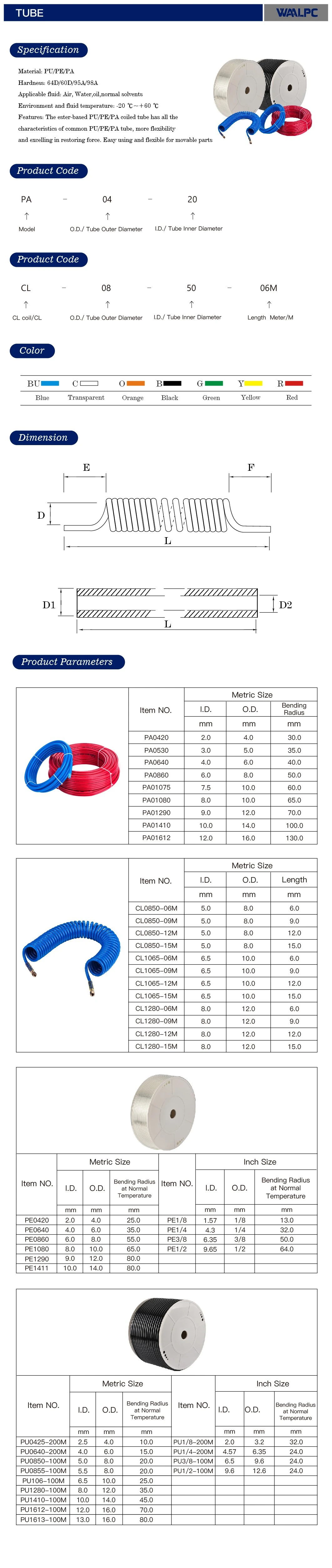
PA Series (Nylon) – I.D. from 2.0mm to 12.0mm, working temperature -20°C to +60°C. Good pressure resistance and excellent flexibility for movable parts.
PE Series (Polyethylene) – Metric and inch sizes, I.D. from 1.57mm to 12.0mm. The general-purpose option for air lines and pneumatic controls.
PU Series (Polyurethane) – I.D. from 2.5mm to 13.0mm, with inch equivalents. The best choice for flexibility, kink resistance, and long service life.
CL Series (Coiled Tubing) – Available in 6m, 9m, 12m, and 15m lengths. Keeps tools connected without dragging loose hose across the floor.
All hoses work with air, water, oil, and normal solvents. Standard colours include blue, transparent, orange, black, green, yellow, and red. Custom colours available on request.
【Advantage】– Why these hoses earn their place
The first thing people notice is the flexibility. PU tubing in particular stays soft and pliable even in cooler temperatures, where cheaper hoses start to stiffen and kink. That flexibility translates directly into fewer interruptions – no stopping to untangle a hose or replace a cracked line.
The second thing is durability. The ester-based PU/PE/PA formulation used in these hoses resists abrasion, weathering, and the kind of repeated flexing that kills inferior tubing. They're designed for real workshop conditions – not just clean laboratory setups.
And then there's the range. With four materials and dozens of sizes – from 1.57mm up to 16mm outside diameter – you can standardise on one supplier for almost every pneumatic hose requirement in your facility.
【Benefit】– What it means on the shop floor
Let's keep this practical.
Fewer replacements. A hose that lasts three years instead of six months pays for itself many times over – not just in hose cost, but in the labour and downtime saved.
Less air waste. A cracked or kinked hose leaks compressed air. Leaks cost money. Quality hose keeps the air where it belongs – in your system.
Easier installation. Flexible hose routes easily around obstacles, bends without kinking, and stays put once installed. That speeds up machine assembly and makes maintenance less frustrating.
Simpler inventory. One supplier, four materials, dozens of sizes. You don't need to juggle multiple product lines or wonder whether the hose you have on the shelf is the right one for the job.
【Evidence】– The numbers behind the hose
We test these hoses the same way we test everything else – under conditions that mimic real use, not laboratory ideals.
The PA series handles temperatures from -20°C to +60°C, with hardness ratings of 64D, 60D, or 95A depending on the specific material. The ester-based formulation provides excellent flexibility and restoring force – important for applications where the hose is constantly moving.
The PU series offers the best kink resistance and flex life, with bending radii as tight as 10mm for the smallest sizes. The PE series is the cost-effective option for fixed lines and general pneumatic controls.
These hoses are installed in thousands of pneumatic systems worldwide – on packaging lines, assembly stations, textile equipment, robotics cells, and more. They've been proven in the field for years.
Technical Data Table
| Parameter | PA Series | PE Series | PU Series | CL Series |
|---|---|---|---|---|
| Material | Nylon | Polyethylene | Polyurethane | Polyurethane (coiled) |
| Working Fluid | Air, water, oil, normal solvents | Air, water, oil, normal solvents | Air, water, oil, normal solvents | Air, water, oil, normal solvents |
| Temperature Range | -20°C ~ +60°C | -20°C ~ +60°C | -20°C ~ +60°C | -20°C ~ +60°C |
| Hardness | 64D / 60D / 95A | - | - | - |
| I.D. Range | 2.0mm ~ 12.0mm | 1.57mm ~ 12.0mm | 2.5mm ~ 13.0mm | 5.0mm ~ 8.0mm |
| O.D. Range | 4.0mm ~ 16.0mm | 3.2mm ~ 14.0mm | 4.0mm ~ 16.0mm | 8.0mm ~ 12.0mm |
| Length Options | 100m / 200m reels | 100m / 200m reels | 100m / 200m reels | 6m / 9m / 12m / 15m |
| Standard Colours | Blue, transparent, orange, black, green, yellow, red | Blue, transparent, orange, black, green, yellow, red | Blue, transparent, orange, black, green, yellow, red | Blue, black |
| Applications | Movable parts, general pneumatic lines | General pneumatic controls, air lines | Flexible connections, moving tools | Tool connections, tidy installations |
Video
FAQ
1. What's the difference between PA, PE, and PU tubing?
PA (nylon) offers the best pressure and temperature resistance. PE (polyethylene) is the budget-friendly option for general air lines. PU (polyurethane) delivers the best flexibility and kink resistance – ideal for moving tools and tight routing.
2. Which one should I choose for a moving application?
PU tubing is usually the best choice for moving applications. It stays flexible, resists kinking, and handles repeated flexing better than PA or PE.
3. What sizes are available?
I.D. from 1.57mm up to 13.0mm, with O.D. from 3.2mm up to 16.0mm depending on the series. Metric and inch sizes are both available.
4. What colours can I get?
Standard colours include blue, transparent, orange, black, green, yellow, and red. Custom colours available on request.
5. What's the temperature range?
-20°C to +60°C for all series.
6. Do you offer coiled tubing?
Yes. The CL series is available in 6m, 9m, 12m, and 15m lengths – ideal for keeping tools connected without dragging loose hose across the floor.
Installation & Maintenance Tips – A few things we've learned from the field
We've been around enough workshops to know that small details make a big difference. Here are a few things worth keeping in mind:
Cut the tube squarely. A clean, perpendicular cut is the difference between a leak-free connection and a slow leak. Use a proper tube cutter – not a pair of side cutters.
Don't over-bend. Every hose has a minimum bend radius. Going tighter than that causes kinks and premature failure. Check the specification for your specific size.
Keep it away from heat sources. Even though these hoses handle up to 60°C, prolonged exposure to hot surfaces will shorten their life. Route them away from exhaust manifolds, heaters, and hot pipes.
Use the right fittings. Push-in fittings work best with PU, PA, and PE tubing. Make sure the fitting and tubing are compatible before assembly.
Replace damaged hose promptly. A small crack or abrasion point will grow under pressure. Replace the hose before it fails completely – it's cheaper than the downtime.
That's about it. A few simple habits and these hoses will keep performing for years.
Hot Tags: pneumatic air hose, China pneumatic air hose manufacturers, suppliers, factory


